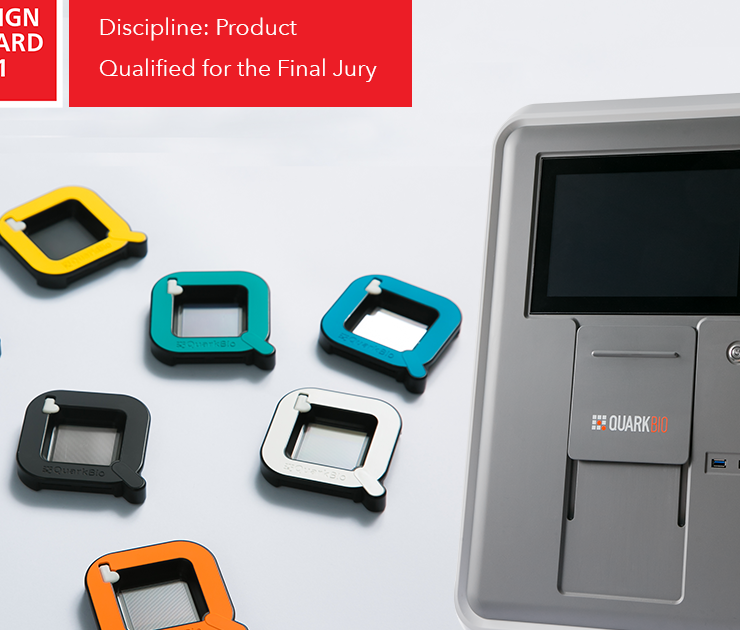

Our technology blends breakthroughs across a variety of disciplines, mostly silicon chip technology, optoelectronics, and wet-lab molecular biology. Genomic DNA will be sequenced by a fluorescent method in tiny wells on a composite chip, each chip spanning up to a million of reaction sites; the sequence generated from each site will be assembled into an individual's genome. To achieve such an ultra-high throughput, and to circumvent resolution limits raised by the use of microscopes, we designed a three-tiered chip, with each reactive site immediately on top of its corresponding photon-sensing component, a photodiode. In other words, sequencing is carried out on top of a photodiode in independent and integrated units, hence our technology name: sTOP.

Figure 1: sTOP technology and chip outline.
Our revolutionary sTOP chip (panel a) spans hundreds of thousands of reactive units (panel b), each one composed of an embedded reactive nanowell with its light source immediately on top of filtering and photon-sensing tiers (panel c, green, orange and blue cross-sections, respectively). Our approach relies on the sequential conversion of photons to electrons, and finally in genome sequence (panel c, steps 1-5). See text for further details.
The conceptual design of this revolutionary, patent-pending technology is sketched in Figure 1. Of a small size (about a square inch), the sTOP chip spans up to millions of sequencing units (Fig. 1, panels a-b). Each unit comprises three tiers, which are layered on top of one another from the bottom upon manufacturing (Fig. 1, top panel); that is, the filtering tier (orange) is built upon the photo-sensing one (blue), eventually the light-emitting tier (green) is laid on top of the filters. A nanowell is embedded in the top tier (Fig. 1, panel c, green), immediately surrounded by a light source. It is very small: the diameter at bottom is one hundred nanometers or less, and the total volume excitable by the surrounding light source is below 0.001 cubic micrometers. This very confined space is subject to a light of very high intensity (1kW/cm2), about that of 10,000 noontime suns. Hence, as the sTOP chip comprises millions of such reactive nanowells, it spans millions of local, tiny light storms. In each of these storms, one fluorescent molecule can be detected when present locally in the reactive volume, and be singled out from an environment highly concentrated in fluorophores (ca. μM).
How does our technology proceed? From the sides of the nanowell emanates light at a particular wavelength, which excites fluorescently labeled reagents present in the well (Figure 1, steps 1 and 2, respectively). The emitted light is transmitted and filtered through the ca. 2-micrometer-thick filter tier (step 3.), and converted into electric signal by a specially designed photodiode underneath (step 4.). The electric signal is in turn handled by integrated circuits adjacent to each diode, and transformed into a digital format suitable for further informatics analyses (step 5.). In summary, our photo-sensor tier pushes the boundaries of CMOS technology to an unprecedented sensitivity.
Let us envision now the application of a sTOP chip to DNA sequencing. What will actually be monitored real-time is the progress of a DNA synthesis reaction, as illustrated in Figure 2. In brief, in a DNA synthesis reaction, the building blocks of DNA, nucleotides, are incorporated into a novel strand of DNA by an enzyme ("a DNA polymerase"), based on a molecule of single-stranded DNA (the "template"), and initiated from a primer (in this case, a generic single-stranded DNA sequence). What nucleotide is incorporated depends uniquely on the corresponding nucleotide in the template strand. That is, if the template reads T (G), the nucleotide to be incorporated is A (C), and conversely. This very simple rule is at the root of most, if not all, DNA sequencing technologies currently available.

Figure 2: Sequencing by continuous synthesis in the sTOP chip's reactive nanowell.
Diagrammatic representation of (a) the indirect-read sequencing approach and (b, c) the underlying process of sequencing-by-continuous-synthesis of a single DNA molecule in a reactive sTOP chip nanowell.
(a) Strands of DNA are depicted as strings of beads, with each bead corresponding to a nucleotide. Sketched are the template and nascent strands (top and bottom, respectively) associated through the clamp of the DNA polymerase reactive site (transparent white structure).
(b) Let us imagine all four nucleotides labeled differently, and a "G" (label emitting green light) being incorporated into the nascent DNA strand. Upon incorporation, the label is subject to light emanating from the sides of the nanowell (light blue colors), and emits in turn a light of a characteristic wavelength (the light cone of –in this particular case- green color). While the excitation (blue) light is blocked by the filter unit immediately below, this fluorescent light is not, and is eventually detected at the bottom photon-sensing unit.
(c) Raw data: A typical example. Depicted is the output signal from the photodiode. The profiles are recorded time traces of all four fluorophores (nucleotide labels). That the light illuminates only a very confined volume at the bottom of the nanowell allows discrimination of signals corresponding to effective base incorporation (in this case, a "G") from background noise, due e.g. to simple diffusion of labeled nucleotides in the illuminated space (as shown by shorter peaks of "A", "T" and "C"). See text for further details.
Imagine now that all these reagents are present in the sTOP nanowell, with each nucleotide carrying a different fluorescent tag, excitable by the light source surrounding the bottom of the nanowell. Upon incorporation of a nucleotide into the nascent DNA strand by the DNA polymerase at the bottom of the reaction site, the fluorophore is activated and emits light, the nature of which depends on the nucleotide. This photon signal passes through the filter layer (whereas excitation light does not), to reach the photodiode; there, photons are converted into an electric signal, the properties of this signal are in turn decoded by the logical circuit adjacent to the diode, hence the nucleotide incorporated is identified. If the DNA synthesis reaction does proceed, signals will be measured, which correspond to the successive steps of nucleotide incorporation, and allow sequence determination.
Obviously labeled nucleotides are free in solution in the reaction well, and if hit by the excitation light, the corresponding fluorochromes will generate background signals. The sTOP chip design limits the impact of such signals in two ways. First, only a very confined volume is irradiated, hence a single fluorophore at the very reaction site is picked out from the surrounding labeled molecules. Even if fluorescent nucleotides reach the illuminated site without being incorporated, the corresponding signal will be much shorter than that due to effective incorporation of a nucleotide; this background noise will thus be easily discarded.
Additional features of our sTOP chip include its portability, a low cost of production, a long shelf-life, its range of applications. No sophisticated detection apparatus like microscopes are needed, as the light signal is immediately processed to a digital output at the chip level itself. This portability is unique among other, currently available technologies. No specific production equipment is required, but manufacturing lines of silicon chips for computer use. That no biological material is in contact with the nanowell, the underlying filter and photodiode before proceeding to sequencing, ensures the chip a long shelf life; it is "ready to go" once reagents fill the nanowell. Finally, although we have detailed here only the application of our sTOP chip to ultra-high throughput DNA sequencing, other fluorescence spectroscopy protocols involving single molecules can be envisioned, extending the potential uses for our sTOP chip in the biomedical field.
Altogether, our approach relies on the sequential conversion of photons to electrons, and finally in genome sequence. The revolutionary chip we have designed breaks away the boundaries of classical-optics resolution, and rather shifts the throughput limits to the enzyme's intrinsic properties. Finally, because of its small size and low cost of manufacture, it makes the vision of personal genomics a reality for all, and opens the door for a variety of genomics applications. |